Fly Me to the Moon Review
 Sponsored content! Ever since The Shadows of Luclin expansion was released for EverQuest, I’ve been fascinated by lunar adventures. Being the casual player I am, I have never reached Luclin, but I did incorporate the idea into my Terminus and Eremus campaigns. When Kabuki Kaiser approached me with a copy of his hex crawl adventure, Fly Me to the Moon, I couldn’t say no. His approach to moonwalks, though, is very different from the science-fantasy adventures I’m used to. Fly Me to the Moon describes a fantastic landscape deeply rooted in the Moon as it lived in people’s imagination before the cold reality of modern science and spaceflight sucked the fun out of it.
Gonzo doesn’t feel like the best word to describe Kabuki Kaiser’s Moon. Baroque and dreamlike are more appropriate. Its Appendix N lists titles like Kepler’s Somnium, Raspe’s Münchausen, Dunsany’s Pegana, even Sailor Moon. Good old Manual of the Planes is also mentioned, and we’ll see later why. Reading the book also reminded me of Neverland from Peter Pan, Wonderland from Alice’s Adventures in Wonderland, and Lovecraft’s Dream Cycle, despite those books not being named among the inspirational sources.
Fly Me to the Moon is an elegant looking book, even in pdf format. It’s dominated by lovely hues of blue, with bits of purple and yellow popping up here and there for highlighting. The illustrations are mostly silhouettes, some of them dwelling in the background as pale watermarks. The Moon also gets a lovely map with 10-mile hexes as coordinates, as it should be for hex crawls. Alas, the usage of dark blue as the base colour and the nature of the Moon’s landscape all work to the detriment of readability and printer friendliness.
The book has a simple but effective two-column layout and legible fonts. The writing is terse, but not overly so. It has a stream-of-consciousness feel to it. There is a point where the writing seems to lose momentum, then it picks up again, and the longest entries seem to gather near the end. Despite what I said above, the text is not unstructured at all, but would definitely benefit from some reordering, more highlighting, and the use of textboxes. The most baffling thing is what the brand new Mathematician class is doing in the middle of the book. It should have been put in the appendix. Some spells are also described between hex entries. It seems handy at first, but they appear multiple times throughout the book, with no cross-reference. Since the spells are all collected in the appendix anyway, it would have been more useful to describe them only there and cross-reference those entries.
 Fly Me to the Moon kicks off by introducing the basics of lunar adventuring. Similar to the planes as seen in Manual of the Planes, the Moon has its own rules. Elemental spells do minimal damage, magic items lose efficiency, plant and animal spells have local variants, and long-distance teleportation drifts. At the same time, sleep, paralysis, and unconsciousness spells are harder to resist, and charm spells have no end. The most impactful change, though, is that it’s impossible to raise the dead. Only reincarnation works, which can happen spontaneously when someone dies. The Moon has its own reincarnation table, with only lunar species on it. There are eleven new weird and flavourful races, including the phase-shifting selenites, the flying and blind batfolk, and the venomous sun spiders, who can only advance as magic-users. Their entries are short, but give enough information to make them playable.
The author might be coy about the system by saying “it’s for generic OSR”, but Fly Me to the Moon seems to lean heavily towards AD&D, with some B/X-isms slipped in. There are plenty of references to advanced classes, races, spells, and so on. The author also showcases a good deal of system mastery by frequently going into detail about how certain spells, abilities, items, and mechanics affect a situation, instead of leaving everything to DM fiat. I’m not sure if it’s the result of playtesting or thoroughness, but kudos for that!
Of course we all come to a hex crawl for the hexes. Similar to Carcosa, every hex on the Moon has something in it. There are 168 entries in total, and some of them have double entries for surface and underground locations. I’m not a fan of fully filled hex crawls. It feels artificial and turns hex-crawling into a laundry list, where the goal becomes checking boxes until you run out of sights to see, instead of getting from point A to point B without getting lost. I prefer goal-driven exploration over FOMO-driven exploration, and maps that have room to breathe. It also makes trekking clunky if you have to stop at every hex to see the local attraction on your way somewhere.
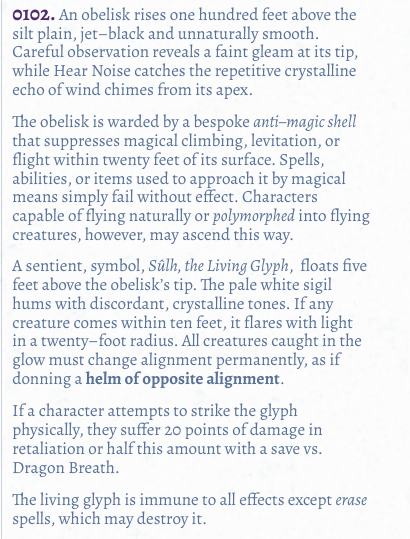
The hex entries themselves are damn good and colourful. They vary from a few-paragraph-long moments frozen in time1 to more than a page-long complex situations. Some of them are standalone, others are part of a bigger picture. There are only eleven settlements on the Moon, with a couple of abodes, citadels, and institutions sprinkled between them. Pallidion is the only one among them that deserves to be called a city, with its impressive population of 10,000.
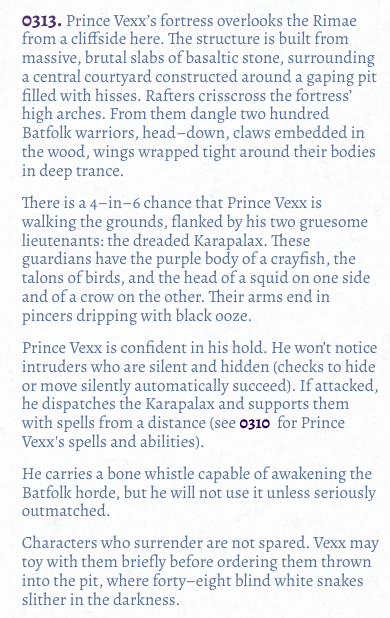 During their adventures characters can encounter vibrant landscapes, strange objects to mess with, and an eclectic bunch of non-player characters—from strange local fauna, through eccentric weirdos, to cosmic entities.2 I have a hard time choosing favourites, so I’ll pick first things that come to my mind. The Moon King and Moon Queen are floating heads with a collection of limbs they change whenever they want. The former is utterly oh-so-random; the latter forgets everything after a meeting. They are also horrible parents, considering their daughter died young, was forgotten by them, and now haunts the Moon as a ghost accompanied by a sentient balloon. Leonardo da Vinci is also stranded here, imprisoned in an emerald well for claiming the Moon does not produce its own light. In a crumbling castle dwells a megalomaniac selenite with a Wand of Splendour called Luna, who is basically a Temu Sailor Moon. There is a train in the south with two horny yochlol ticket inspectors and a bunch of intriguing passengers. And that’s just the tip of the iceberg…
While the tone is usually quirky and whimsical, I did find two entries disturbing. There is a cave where silvery fire beetles can turn characters into beetles for months with a successful attack. For some reason it was important to highlight that the characters can sire offspring with them in the meantime, who will act as familiars once they revert to their original form. There is another place where two male catoblepae plead with the characters to hold down a female catoblepas so they can copulate with her without dying. I know sex in the animal kingdom isn’t about consent, but if they are sentient enough to talk with the players, are they still animals, or not? I want to know for the sake of the alignment graph if the player characters helping them are inseminators or rape accomplices…
The book ends with a meaty appendix that contains spells both old and new, an article about rare forms of lycanthropy, a short history lesson, a colourful collection of 69 cats, stats for a party of NPC adventurers, and of course the aforementioned Appendix N. Speaking of spells, many of them are for the new magic-user sub-class, the Mathematician. Those who like reality altering spells and tampering with probability will love it. It is a class that can be earned by winning a race to Pallidion.
Quibbles aside, this is a fine, fun, and inspiring piece of work. Would I use Fly Me to the Moon for one of my D&D campaigns? Not really, but that’s only because its baroque fantasy doesn’t fit the tone of my more traditional sword & sorcery / high fantasy campaigns. On the other hand, I will totally mine it for my Warhammer homebrew. I’ve been toying with the idea of having an adventure on a Moon messed up by Chaos, and Kabuki Kaiser’s vision is chock full of ideas for that. All it needs is some warpstone and rats…
Rating:
The book is available on DriveThruRPG.
Disclaimer: The DriveThruRPG links on this site are affiliate links. If you buy something through the link, we’ll get some credit for your purchase too.